
When a caterer, bartender or DJ sends your venue "proof of insurance," what lands in your inbox is almost always an ACORD 25 — the standard Certificate of Liability Insurance form. It's one page, it's dense, and most of it is boilerplate. The good news: once you know which five or six boxes matter, you can read one in under a minute.
This guide walks the form top to bottom from a venue's point of view — what each section is, and what to actually check before you let a vendor on site.
What an ACORD 25 is (and isn't)
A certificate of insurance is a snapshot, not a contract. It summarizes policies that exist on the day the certificate was issued. It does not amend the underlying policy, and it doesn't guarantee coverage will still be in force on your event date. That's why the dates and the additional insured wording matter so much: they're the difference between "this vendor had insurance in March" and "your venue is protected at this wedding in October."
The form, section by section
Read it in this order. The numbers below match the callouts on the sample form and the way the ACORD 25 is laid out.
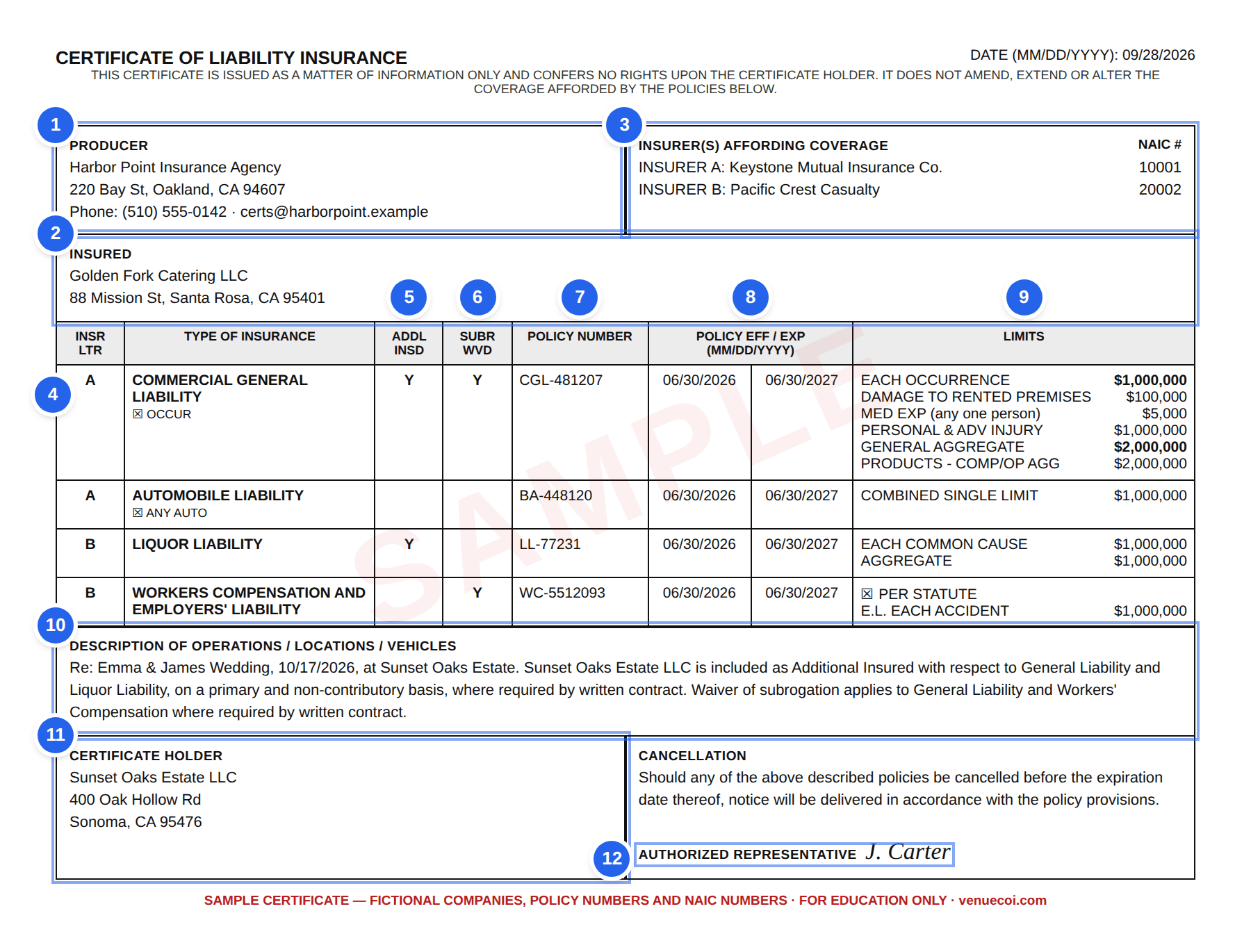
| # | Section on the form | What it is | What to check |
|---|---|---|---|
| 1 | Producer | The insurance agency or broker that issued the certificate | A real agency with a phone/email you could call to verify |
| 2 | Insured | The vendor's legal business name and address | It matches the vendor you're actually hiring |
| 3 | Insurers A–F | Each carrier providing coverage, each with an NAIC number | Real carriers; NAIC numbers present |
| 4 | Coverages grid | The core table: one row per policy type | See the coverage lines below |
| 5 | ADDL INSD column | "Y" if someone is added as additional insured on that line | "Y" on the general liability line if you require it |
| 6 | SUBR WVD column | "Y" if a waiver of subrogation applies to that line | "Y" if your contract requires a waiver |
| 7 | Policy number | The identifier for each policy | Present on every line you're relying on |
| 8 | Effective / expiration dates | The coverage window for each policy | Your event date falls inside it |
| 9 | Limits | The dollar amounts payable | They meet or beat your requirement |
| 10 | Description of Operations | Free-text box (can spill onto an ACORD 101) | Names your venue and the additional insured wording |
| 11 | Certificate Holder | Who this certificate was sent to | Usually your venue — but this alone is not coverage |
| 12 | Authorized Representative | The producer's signature | Present |
The coverage lines (section 4)
Most venues care about the top line — Commercial General Liability (CGL) — but the grid also lists Automobile Liability, Umbrella/Excess, and Workers' Compensation. Each line repeats the same pattern: policy type, ADDL INSD, SUBR WVD, policy number, effective date, expiration date, and limits.
Under general liability you'll see several limit rows:
- Each Occurrence — the most paid for a single incident. This is the headline number (commonly $1,000,000).
- Damage to Rented Premises — for damage to a space the vendor rents/uses.
- Med Exp — small medical payments regardless of fault.
- Personal & Adv Injury — libel, slander and similar.
- General Aggregate — the most paid across the whole policy term (commonly $2,000,000).
- Products – Comp/Op Agg — completed-operations aggregate.
The three checks that matter most
1. Limits meet your requirement
The common baseline most venues require is $1,000,000 per occurrence / $2,000,000 aggregate in general liability. Compare the numbers in the Limits column to your own rule. Bar and catering vendors often need liquor liability on top of general liability where alcohol is served.
2. Dates cover your event
Find the effective and expiration dates on the general liability line. Your event date must be on or after the effective date and on or before the expiration date. A policy that expires two weeks before the wedding is worthless to you — ask for a renewed certificate.
3. Your venue is additional insured — not just certificate holder
This is the one venues get wrong most often. The Certificate Holder box (bottom-left) simply records who the certificate was sent to. It gives your venue no coverage by itself.
What protects your venue is being named as additional insured on the vendor's general liability policy. On the form that shows up two ways together: a "Y" in the ADDL INSD column on the CGL line, and matching wording in the Description of Operations box, such as "Certificate holder is named as additional insured with respect to general liability." If you require a waiver of subrogation, look for the "Y" in the SUBR WVD column and confirming wording.
What this means for your venue
Your caterer. You require $1M/$2M general liability and, because they're serving food that guests eat, you want them named as additional insured. You open their ACORD 25, see $1,000,000 each occurrence and $2,000,000 aggregate, a "Y" in ADDL INSD on the CGL line, and your venue's name in the Description of Operations. Dates cover the event. Approved.
Your bar service. Same limits, but because alcohol is served you also require liquor liability. Their certificate shows general liability but no liquor line. That's a fail — you send it back and ask them to add liquor liability before the event.
The couple's outside DJ. The couple booked a DJ directly. The certificate lists the DJ's business, $1M/$2M general liability, dates that cover the event — but the Certificate Holder is a different venue from a past event, and your venue isn't named anywhere. That's a fail: they reused an old certificate. Ask for one that names your venue as additional insured.
Good COI vs bad COI
| Check | Good | Bad |
|---|---|---|
| Insured name | Matches the vendor you hired | A parent company or a different business |
| GL limits | $1M occurrence / $2M aggregate or higher | Below your requirement, or blank |
| Dates | Cover the event date | Expire before the event |
| Additional insured | "Y" + your venue named in Description of Operations | Only listed as certificate holder |
| Liquor liability (bar/catering) | Present where alcohol is served | Missing |
| Producer | Verifiable agency | No contact details |
A note on trust
Because a certificate is just a summary, it can be edited. You don't need to be suspicious of every vendor, but watch for mismatched fonts, missing NAIC numbers, or a producer with no contact details. When a booking is high-value, confirm coverage directly with the producer listed on the certificate.
Reading one ACORD 25 is quick. Reading twenty of them per event, tracking which vendor's coverage expires when, and chasing the ones that come back wrong is where the time goes — that's the part VenueCOI automates.